




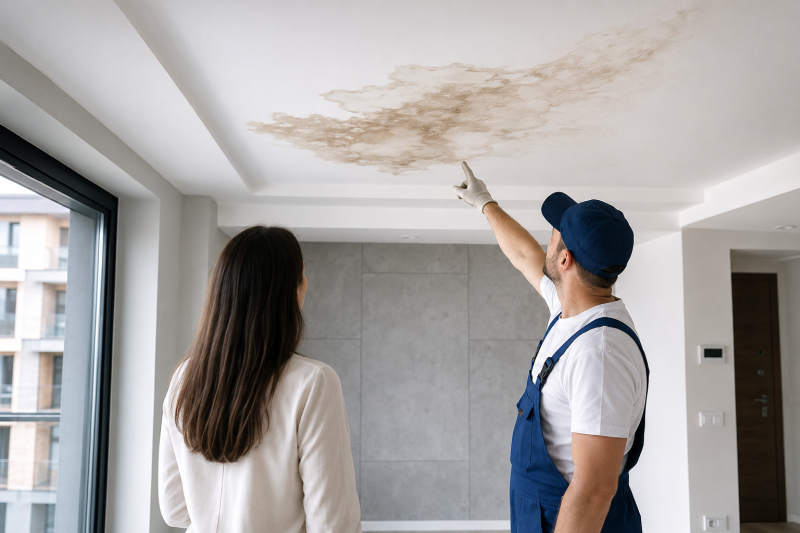
Key information for a buyer of an apartment from a Polish developer
- A Polish developer may be liable for real estate defects under statutory warranty rules if the conditions for the seller’s liability are met.
- An apartment defect may concern both visible elements identified during handover and hidden defects revealed only after moving in.
- Defects in common parts may be pursued by apartment owners and, in certain situations, also by a Polish housing community after an assignment of claims.
- As a rule, a real estate defect should be identified before the expiry of 5 years from the date the property was handed over to the buyer.
- The buyer should report defects in writing and secure evidence, in particular photographs, handover reports, correspondence and technical opinions.
- As a rule, the developer cannot avoid liability by referring the buyer to the contractor, subcontractor or manufacturer of the defective element.
- In urgent cases, substitute performance of defect rectification may be possible, but it requires careful legal and technical analysis.
Developer liability for real estate defects in Poland
Under the current legal framework, the analysis of developer liability for real estate defects in Poland is based primarily on the Polish Act of 20 May 2021 on the Protection of the Rights of the Purchaser of a Residential Unit or Single-Family House and the Developer Guarantee Fund, commonly referred to as the new Polish Developer Act, and on the provisions of the Polish Civil Code on statutory warranty for sales.
To the extent not regulated by the Polish Developer Act provisions concerning apartment handover and the procedure for reporting defects, the provisions of the Polish Civil Code on statutory warranty for sales apply accordingly to the developer’s liability for physical and legal defects. In practice, this means that the developer, as the seller, is liable to the buyer if the sold property has a physical or legal defect.
A physical defect in real estate should be understood in particular as a situation where the apartment or common part has properties that reduce its value or usefulness in view of the purpose specified in the agreement, arising from the circumstances or resulting from the intended use of the item. A defect may also consist in the absence of properties whose existence was assured by the developer, or in handing over the apartment in an incomplete condition.
The definition of a defect is broad. It may include structural, workmanship and installation defects, as well as problems with insulation, ventilation, acoustics, damp, leaks, window joinery, balconies or the quality of materials used in the development.
Case law also indicates that when assessing whether a defect exists, not only a strictly technical criterion is relevant, but also a functional criterion, covering the purpose of the item and the possibility of normal use in accordance with the agreement and its properties. This means that a real estate defect may exist not only where the apartment or building breaches specific technical standards, but also where a particular irregularity reduces its usefulness, value, aesthetics or comfort of use.
This approach is confirmed in the case law of the Polish Supreme Court, which emphasises the functional nature of the concept of a defect, see the Polish Supreme Court judgment of 9 March 2006, case no. I CSK 147/05, and the Polish Supreme Court judgment of 28 November 2007.
Legal literature also indicates that a construction defect may be any adverse and unintended property of a constructed building which hinders its use in accordance with its intended purpose, its maintenance or reduces its aesthetics or user comfort, see G. Chrabczyński, A. Heine, “Definicja wady budowlanej”, Inżynier Budownictwa, March 2006.
How long does developer liability for real estate defects in Poland last?
Developer liability for real estate defects in Poland is not unlimited in time. Under Article 568 § 1 of the Polish Civil Code, the seller is liable under statutory warranty if a physical defect in real estate is identified before the expiry of 5 years from the date the item was handed over to the buyer.
This means that the buyer of an apartment should verify the condition of the apartment and the common parts within that period and should not delay reporting defects. As a rule, the claim for defect rectification becomes time-barred one year from the date the defect is identified, while in the case of a consumer this period cannot end before the expiry of the 5-year statutory warranty period.
In practice, it is best to report defects to the developer immediately after they are identified. Late reporting may lead to evidentiary difficulties, a dispute over the cause of the defect, allegations of improper use of the apartment or the risk that claims become time-barred.
If the defect was already revealed at the technical acceptance stage, it is also worth reviewing the procedure described in our article on acceptance of the property from the developer and the procedure for rectifying defects under Polish law.
Who can demand rectification of apartment defects and defects in common parts?
If the defects occur in the apartment itself, the demand to rectify them should be made by the owner of the apartment or the co-owners, for example spouses.
The situation is more complex where the defects concern common parts of the property, for example structural walls, foundations, roof, façade, lift shaft, water and sewage risers, central heating installation, gas installation, ventilation, staircases or underground garage. A person who buys an apartment also acquires a share in the common property, which means that statutory warranty may also cover a fractional share in that part of the property.
Apartment owners may transfer to the housing community their rights to pursue claims connected with physical defects in the common property. The admissibility of this solution was confirmed by a resolution of 7 judges of the Polish Supreme Court of 29 January 2014, case no. III CZP 84/13.
From a practical perspective, assigning claims to a housing community may have many advantages. The community then takes over the conduct of the case and individual owners do not have to pursue claims concerning common parts separately. However, resolutions, claim assignment agreements and the scope of authorisation for the management board must be prepared correctly.
This issue is discussed in more detail in our articles on construction defects in common areas in Poland and housing community claims against a developer and on common mistakes in housing community resolutions concerning defect claims against developers.
What can the buyer claim from the developer in Poland? Compensation for apartment defects
Under statutory warranty for apartment defects, the buyer may, depending on the type of defect and the circumstances of the case, primarily demand:
- rectification or repair of the real estate defect at the developer’s cost,
- a reduction in the apartment price corresponding to the impact of the defect on the property’s value,
- withdrawal from the agreement if the defect is material and the statutory conditions for such a demand are met,
- compensation from the developer if the buyer has suffered additional damage as a result of the defect or improper performance of the obligation.
The scope of the demand should be clearly formulated in a letter addressed to the developer. The type of claim should be proportionate to the nature of the defect. A single wall crack requires a different response than a serious structural defect, damp in the apartment, ineffective ventilation or a defect that prevents normal use of the apartment.
In some cases, alongside claims arising from real estate defects, claims related to developer delay may also arise. We discuss this issue in our article on contractual penalty for developer delay in Poland.
It is also advisable to exercise caution when signing a notarial deed or final documents prepared by the developer. If the developer expects the buyer to waive claims, it is worth checking the legal consequences of such a statement. We discuss this in our article on waiver of claims in a notarial deed in Poland.
In cases concerning hidden defects in real estate in Poland, it is important to determine whether the defect could have been detected by the buyer during ordinary inspection of the apartment. Case law indicates that fraudulent concealment of a defect consists in intentional conduct by the seller aimed at making it more difficult for the buyer to detect the defect, for example by hiding it, masking it or failing to inform the buyer about a known defect in the property, see, among others, the Polish Supreme Court judgment of 1 April 2003, case no. II CKN 1382/00.
At the same time, the mere fact that the buyer inspected the apartment before purchase does not automatically mean that they knew about all defects. If specific defects were not visible to the naked eye, they may be treated as hidden defects. For example, the Court of Appeal in Białystok, in its judgment of 8 July 2016, case no. I ACa 172/16, indicated that even repeated and detailed inspections of the apartment do not necessarily justify the conclusion that the buyer knew about the defects if those defects could not be identified without specialist knowledge or technical tests.
Can a developer refer the buyer to the manufacturer or subcontractor?
In practice, after a real estate defect is reported, the developer may try to refer the buyer to the manufacturer of the defective element, contractor or subcontractor, for example the manufacturer of windows, doors, installations, finishing materials or the company that performed specific construction works. This argument usually does not solve the buyer’s problem.
The developer is the party to the apartment sale agreement and the buyer may direct claims arising from the statutory warranty for real estate defects against the developer. Any settlements between the developer and the manufacturer, contractor or subcontractor are generally an internal matter between those entities and should not deprive the buyer of the possibility to pursue claims directly against the developer.
It is not decisive whether the developer performed specific works itself or entrusted them to a professional contractor or subcontractor. Case law indicates that a developer, as a professional, should pay attention to the quality of products and services ordered from subcontractors, and the mere fact that the manufacturer holds certificates does not prove that the product is free from defects. As held by the Regional Court in Suwałki in its judgment of 6 June 2017, case no. I Ca 159/17, it is excluded for the debtor to rely on the absence of fault in supervision or the absence of fault in selection.
This means that the developer should not avoid liability towards the buyer only because the defective element was made or supplied by another entity. From the buyer’s perspective, the key point is that the apartment or common part was delivered with a defect, and a claim based on statutory warranty or improper performance of the agreement may be brought directly against the developer.
Substitute performance of defect rectification in Poland
A frequent practical problem is a situation where the developer refuses to rectify the defect or delays the repair. As a rule, in the event of the debtor’s delay in performing an obligation to act, the creditor may request the court to authorise the performance of the act at the debtor’s cost, while retaining the claim for damages.
Under Article 480 § 3 of the Polish Civil Code, in urgent cases the creditor may, while retaining the claim for damages, perform the act without court authorisation at the debtor’s cost, or remove at the debtor’s cost what the debtor has done contrary to the obligation.
This may be relevant especially where the real estate defect threatens health, life or the occurrence of serious damage. Examples include severe mould in apartments or common parts, leaking insulation causing flooding of technical rooms, risk of electric shock, fire hazard or an emergency condition of building elements.
Substitute performance at the developer’s cost requires caution. The buyer should be able to demonstrate that the conditions of urgency existed, that the scope of works was necessary and purposeful, and that the costs were justified. Therefore, before commissioning works to a third party, it is advisable to obtain legal and technical assessment and secure photographs, reports, specialist opinions, cost estimates and correspondence with the developer.
What evidence should be secured in a dispute with a developer over real estate defects?
Cases concerning real estate defects very often turn on documents and technical opinions. From the first report of defects, the buyer should organise the evidentiary material carefully.
In particular, the following should be secured:
- the development agreement,
- the agreement transferring ownership,
- the information prospectus and technical appendices,
- the apartment handover protocol and photographic documentation from handover,
- written reports of defects submitted to the developer and the developer’s replies,
- photographs, recordings and measurements showing the defect and its development over time,
- technical opinions, expert reports, cost estimates and repair offers,
- evidence of costs incurred, including invoices, bills and bank transfer confirmations.
In some cases, especially where there is a risk that defects may be removed, changed or worsen before proceedings begin, it is also worth considering securing evidence from an expert opinion and inspection before court proceedings.
Can the buyer claim reimbursement of the cost of a private technical expert report?
In a dispute concerning real estate defects from a developer in Poland, the buyer may claim not only defect rectification or a price reduction, but also reimbursement of the costs incurred to obtain a private technical expert report. If the developer refuses to rectify the defects or delays the repair, and an expert report is needed to determine the cause of the problem, the scope of repair works, the cost of removing the defects or to effectively pursue claims in court, the cost of such report may constitute damage resulting from improper performance of the obligation by the developer. The legal basis for such a claim may be Article 471 of the Polish Civil Code in conjunction with Article 361 of the Polish Civil Code, because the expenditure on the expert report remains in a normal causal link with the defects in the apartment or common parts and the developer’s conduct.
This position is confirmed by the case law of the ordinary courts, which accepts that the costs of expert reports aimed at proving defects in the sold item may be reimbursed. Such costs are a normal consequence of the defect in the sold item and remain in an adequate causal link with its occurrence.
Practical example from Polish case law:
“An expert report prepared before court proceedings may be an important basis for awarding damages. In such a case, the cost of the expert report constitutes damage subject to compensation” (Polish Supreme Court judgment of 2 September 1975, case no. I CR 505/75).
Defects in common property and actions of a Polish housing community
If a defect concerns common parts, individual actions by a single owner may be insufficient. A Polish housing community should consider whether it is necessary to collect documentation, obtain a technical opinion, accept assignments of claims from owners, adopt a resolution on pursuing claims and bring a case against the developer.
However, a defectively drafted resolution may be challenged and, in certain situations, its implementation may be stayed. Therefore, in larger cases concerning defects in common parts, it is worth ensuring not only a technical expert report, but also the correct construction of resolutions and powers of attorney for the housing community management board. We discuss the procedure for challenging resolutions in our article on challenging a housing association resolution in Poland, and the interim protection mechanism in the article on staying the implementation of a housing community resolution as interim relief.
This topic is discussed in more detail in our publication on construction defects in common areas in Poland and housing community claims against a developer.
Verdict Partners comment
The statutory warranty for real estate defects provides important protection for the buyer. Developer liability arises by operation of Polish law and does not depend on whether the agreement contains additional provisions concerning defects. If the purchased apartment or common parts are affected by defects, the buyer should not delay reporting the claims.
As a first step, a written defect report should be sent to the developer. It should describe the problem, specify the demand and set a deadline for the developer to take a position or remove the defects. In our experience, in many cases developers acknowledge some defects and attempt to remove them. However, if the developer refuses, proposes only superficial repairs or delays the matter, the buyer may pursue claims in court.
In more serious cases, especially those involving structure, damp, insulation, ventilation, acoustics or common parts, a properly prepared technical opinion and a precise definition of claims are crucial. Not every demand will be adequate to the type of defect, so before referring the matter to court it is worth determining whether the appropriate remedy is repair, price reduction, compensation, substitute performance or another legal step.
How we can help with real estate defects and claims against developers in Poland
Verdict Partners assists apartment buyers, property owners and housing communities in matters concerning real estate defects, developer warranty and claims against Polish developers.
The scope of our assistance includes in particular:
- analysis of the development agreement, notarial deed, handover protocol, correspondence and technical documentation,
- assessment of whether the identified defects may constitute real estate defects justifying claims against the developer,
- preparation of a defect report, demand for defect rectification, demand for a price reduction or demand for compensation,
- coordination of cooperation with a construction expert, supervision inspector or another technical specialist,
- determination of the value of claims, including repair costs, reduction in the apartment value, additional damage and costs of technical opinions,
- representation in negotiations with the developer, mediation or court proceedings.
Each case concerning real estate defects requires an individual assessment. A single apartment defect is analysed differently from defects in common parts, and a different approach is required where substitute performance or court proceedings against a developer may be necessary.
FAQ
Not every minor imperfection will justify significant claims. However, if the defect reduces the value or usefulness of the apartment, results from improper performance of works or deviates from the agreement, design or assurances given by the developer, it may form the basis for statutory warranty liability.
As a rule, the buyer directs claims to the developer as the seller of the apartment. The developer should not shift liability to subcontractors or manufacturers, even if they physically made the defective element.
As a rule, the seller is liable under statutory warranty if the real estate defect is identified before the expiry of 5 years from the date the item was handed over to the buyer. However, the buyer should not delay reporting the defect, because late action increases evidentiary and litigation risks.
In certain situations, substitute performance may be possible, especially in urgent cases. Before taking such action, evidence should be secured and it should be assessed whether the conditions justifying charging the developer with the costs are actually met.
In many cases, yes. An opinion from a construction expert or another specialist may help determine the cause of the defect, the scope of necessary repairs, the cost of removing the defect and the link between the defect and the developer’s conduct.
This may be possible if the expert report was purposeful, necessary to determine the cause of the defect, the scope of repair or to pursue claims, and its cost remains connected with the developer’s improper performance of the agreement. In such a situation, the cost of a private technical opinion may be pursued as an element of compensation.