



The most common defects in the common parts of properties
The most common defects in the common parts of multi-family buildings include, in particular:
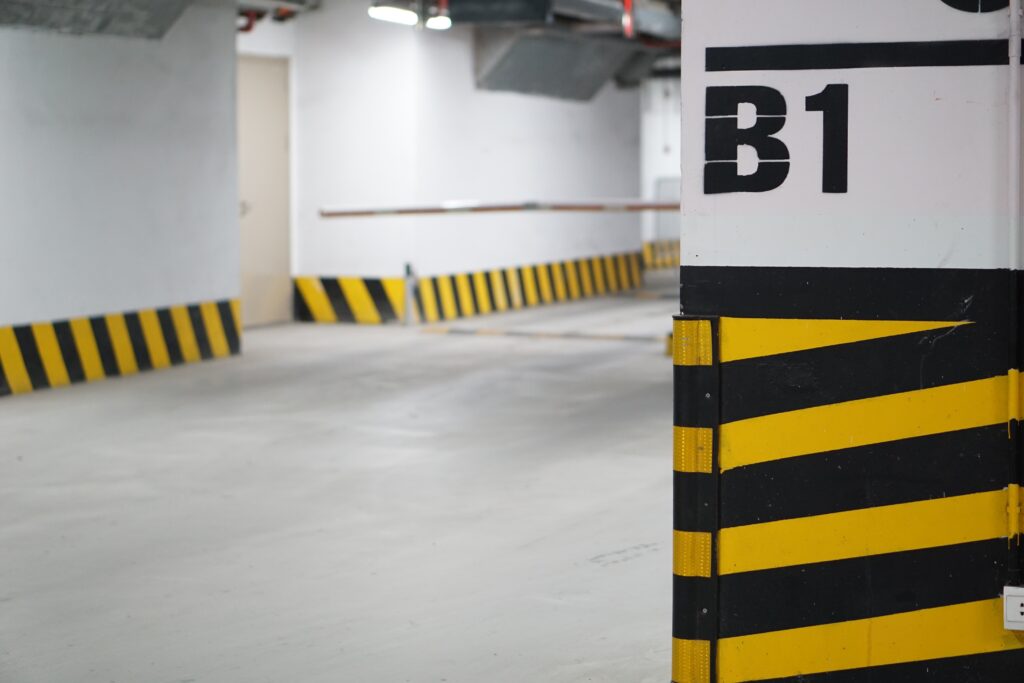
- flooding and damp in underground garages, leading to the growth of mould and structural degradation,
- water seepage and leaks in the area of terraces and flat roofs,
- cracks in the façade, detachment and loss of plaster,
- defects in ventilation, heating, water supply and drainage systems (including service risers),
- leaks within structural expansion joints,
- groundwater seeping into lift shafts and service rooms,
- damage to ceramic cladding in stairwells,
- leaks around service penetrations through ceilings and walls (missing or faulty sealing of penetrations),
- leaks within patios and internal courtyards,
- problems relating to the building’s sound insulation.
Can the residents’ association bring a claim against the developer?
A housing association is an organisational unit referred to in Article 33¹ of the Polish Civil Code, established by operation of law upon the separation of the first flat in the building. Consequently, it has legal capacity, which means that it may acquire rights, incur obligations and act as a party in court proceedings.
In practice, however, the question arises as to whether a housing community is entitled to bring claims against the developer in respect of defects in the common parts of the property, in particular under the warranty of quality.
As a general rule, claims under the warranty are available to the purchasers of the flats as buyers within the meaning of Article 556 of the Polish Civil Code. At the same time, it should be borne in mind that the owners of the flats are co-owners of the common property, and in accordance with Article 209 of the Polish Civil Code, each co-owner may independently take steps to preserve the common right, including pursuing claims aimed at protecting that right.
If, however, the issue concerns only a specific apartment and not the common property, the owner should first analyse the procedure for accepting the apartment from the developer and reporting defects in the apartment.
Case law also recognises the possibility for a housing community to bring claims relating to common property, provided that such claims relate to the management of the common property within the meaning of the Polish Act on the Ownership of Flats, in particular Article 22 of that Act, and the housing community has been authorised to act in this regard by a resolution of the flat owners.
Consequently, provided that certain organisational conditions are met and subject to the relevant resolutions, a housing association may successfully bring an action against a developer in respect of defects in the common parts of the property.
Practical example:
Mr Adam Kowalski purchased a residential flat in a building comprising 100 flats. Upon purchasing the flat, he acquired a share in the common property, which is set out in the notarial deed and constitutes a fraction corresponding to his share in the entire property.
In the event of defects in the common parts of the building, such as flooding of the underground car park or damage to cladding in the communal areas, claims may be pursued in various ways, depending on their nature and the legal framework adopted (either individually by the flat owners or by the housing community acting within the framework of the management of the common property).
This position has been confirmed in numerous judgments of courts. For example, the Polish Court of Appeal in Katowice, in its judgment of 19 August 2016 (case no. I ACa 196/16), ruled that ‘the community has standing to pursue claims transferred to it by way of assignment. The assignment of claims by each of the co-owners of the jointly owned property gives rise to substantive standing. Each of them is entitled to a ‘partial’ right to pursue these claims, determined by the size of their share in the jointly owned property, and the source of these claims is the contract for the sale of the premises. (…) These claims may be assigned to any third party, including a housing community.”
Practical example:
The cost of repairing a leak in the building’s roof amounts to PLN 100,000 and constitutes damage to the common property.
A group of flat owners, representing a total of 70% of the shares in the common property, have entered into agreements with the housing association to assign the claims they hold against the developer. In such a case, the housing association acquires standing to pursue claims to the extent covered by the assignments made.
If the assignment agreements cover claims in proportion to the shares held by individual owners, the association may pursue a claim to the extent resulting from the sum of the claims effectively acquired. In the example given, this will, in principle, be an amount corresponding to 70% of the value of the damage, i.e. PLN 70,000.
However, the scope of the claim does not automatically follow from the structure of the shares in the property alone, but from the terms of the transfer agreements and their legal validity.
The Polish Supreme Court case law permits the arrangement whereby owners of flats transfer claims relating to defects in the common property to the housing community, which in practice allows claims to be concentrated in a single entity and facilitates their pursuit against the developer. However, this does not imply an automatic transfer of all claims or the exclusion of other admissible grounds for standing to sue.
What resolutions should the housing association adopt before bringing a claim against the developer?
In practice, before bringing a claim against the developer, it is essential for the flat owners to adopt appropriate resolutions setting out the procedure for pursuing claims relating to defects in the common property.
In particular, the resolutions should include:
- consent for the management board to undertake actions exceeding the scope of ordinary management, consisting of entering into agreements to assign claims held by individual flat owners arising from defects in the common property and the enforcement of such claims,
- authorisation for the management board of the owners’ association to conduct pre-litigation and court proceedings against the developer in respect of claims concerning the common property,
- granting the management board authorisation to appoint legal representatives in cases against the developer.
However, the housing community should take particular care when drafting resolutions, so as to avoid errors in the resolutions which could be successfully challenged under Article 25 of the Act on the Ownership of Flats, and consequently lead to their annulment by the court. A defectively drafted resolution may not only be set aside, but in certain cases the unit owner may also file an application to stay the implementation of the housing community resolution for the duration of the proceedings, which may delay the pursuit of claims against the developer.
Housing association – claims against the developer
A housing community may bring claims against a developer under two specific regimes of liability:
- under the warranty for physical defects in goods (Article 560 et seq. of the Polish Civil Code) and
- under the general principles of contractual liability for improper performance of an obligation (Article 471 of the Polish Civil Code).
It is accepted in the case law of the ordinary courts that claims under the warranty do not preclude the possibility of seeking damages under the general principles of liability. In its judgment of 2 September 2014 (case no. I ACa 186/13), the Polish Court of Appeal in Łódź stated that rights arising from the warranty do not deprive the buyer of the right to claim full compensation for damage, depending on the circumstances of the case.
A similar position is taken in case law concerning the relationship between the warranty and contractual liability. The Polish Court of Appeal in Katowice, in its judgment of 2 May 2011 (I ACa 269/11), confirmed that exercising rights under the warranty does not preclude the possibility of bringing claims for damages under Article 471 of the Polish Civil Code, in particular in respect of damage resulting from the improper performance of the contract.
Consequently, the purchaser of the property, and in certain cases also the residents’ association acting within the scope of its legal standing, may consider both liability regimes in parallel, depending on the nature of the defect and the method of its rectification.
Claims under the warranty for physical defects in immovable property against the developer (Article 560 et seq. of the Polish Civil Code)
Pursuant to Article 560 of the Polish Civil Code, if the item sold (including immovable property) is defective, the purchaser may request a price reduction or withdraw from the contract. However, in practice, where defects in the common parts of buildings are concerned, the first course of action is often to take steps to bring the property into a condition consistent with the contract, which is supported by the provisions on warranty, in particular Article 561 of the Polish Civil Code.
The buyer may also demand a price reduction, in which case the amount of this claim should correspond to the difference between the value of the property free from defects and the value of the property affected by defects. In judicial practice, this method is sometimes applied to the costs of necessary repair works; however, this does not constitute an automatic or exclusive method of calculating the amount of the price reduction.
The case law of the Polish Supreme Court emphasises that a claim for a price reduction is independent of claims for damages and does not relate directly to the concept of loss, but rather to the relationship between the value of a defect-free item and the value of a defective item (see the Polish Supreme Court judgment of 11 December 2009, V CSK 190/08).
Claims for damages arising from physical defects in a sold item (immovable property) against a property developer (Article 471 of the Polish Civil Code)
A housing community may claim damages from the developer under the general principles of contractual liability arising from Article 471 of the Polish Civil Code. Under this provision, the debtor is obliged to make good the damage resulting from non-performance or improper performance of an obligation, unless they can prove that this occurred as a result of circumstances for which they are not responsible.
This liability generally entails an obligation to compensate for the damage in full, with the method of redress being determined in accordance with the general principles of civil law.
Pursuant to Article 363 § 1 of the Polish Civil Code, compensation for damage may be provided either by restoring the previous state of affairs or by payment of an appropriate sum of money. The choice of the method of compensation generally takes into account the circumstances of the case, including the nature of the damage and the feasibility and appropriateness of restoring the previous state of affairs.
Case law and legal doctrine emphasise that, in contractual relationships, monetary compensation is most commonly accepted as the primary form of redress, particularly where restoration to the previous state would be impractical or unduly difficult (cf. A. Rzetecka-Gil, The Civil Code. Commentary. Obligations – General Part, LEX/el. 2011).
Housing association – proceedings for defects – drafting the statement of claim
If a housing association decides to pursue a claim for the rectification of defects in the common property, the claim should be formulated as precisely as possible, covering both the scope of the identified defects and the method of their rectification.
In practice, it is recommended that, before bringing an action, an independent technical opinion be obtained, specifying the nature of the defects and a technically sound method of repairing them.
If there is a risk that the technical condition of the building may change before evidence can be taken in the proceedings, the housing community should also consider securing evidence by means of an expert opinion or inspection before trial.
Example of a claim:
We request that the defendant, XYZ sp. z o.o., be ordered to rectify the defects in the common property of the ‘Nasz Dom’ Housing Association building, situated at 1 Wypoczynkowa Street in Warsaw, by carrying out the following works:
- repair of defects in the resin-based surface with grit on the two ramps leading to the underground car park and the laying of a new surface in this area in accordance with best construction practice,
- removal of defective concrete paving stones (cracked and discoloured) on a section of the pavement covering an area of approx. 8 m² by the entrance gate to the underground car park, and laying of new concrete paving stones free from defects,
- rectification of faults in the building’s roof drainage system, namely the failure to protect roof drains against the ingress of debris (including roof aggregate), and the installation of appropriate technical safeguards to ensure the proper functioning of the drainage system.
Should the Court not uphold the claim requiring the defendant developer to remedy the defects in the common property, it is reasonable to submit a contingent claim seeking an award of appropriate sums of money corresponding to the costs of remedying those defects.
Example of a contingent claim:
We request that the defendant, XYZ sp. z o.o., be ordered to pay the following sums to the ‘Nasz Dom’ Housing Association:
- 30,000 zł to cover the costs of rectifying defects in the resin surface on the ramps leading to the underground car park and laying a new surface in accordance with best construction practice,
- 25,000 zł for the cost of rectifying defects in the concrete paving on a section of the pavement by the entrance gate to the underground car park and laying new paving,
- PLN 27,000 to cover the costs of rectifying faults in the building’s roof drainage system, consisting of a lack of adequate protection for the roof drains against the ingress of debris.
Claim against the developer – limitation period for claims
Pursuant to Article 568 § 1 of the Polish Civil Code, the seller is liable under the warranty for defects in the property if the defect is discovered within five years of the date on which the property was handed over to the buyer. In the case of property, the moment of handover to the first purchaser of a unit within a given development is of significant importance.
Claims brought under Article 471 of the Polish Civil Code, i.e. for breach of contract, must be assessed separately. These claims are subject to the general limitation periods set out in Article 118 of the Polish Civil Code, which, as a rule, amount to six years.
Case law emphasises that claims under the warranty and claims for damages under Article 471 of the Polish Civil Code are distinct in nature and are subject to separate legal regimes, including different limitation rules.
When does the limitation period for a claim for the rectification of defects in common parts begin to run?
There is no uniform and fully established practice in this regard. It is generally accepted that each owner may have a separate starting point for the limitation period, which may lead to differing expiry dates for claims. Consequently, the safest approach is to calculate the limitation periods individually for each purchaser.
Summary
The developer’s liability for defects in the common parts of a property is one of the most common issues encountered in the day-to-day operation of housing communities. Such defects often become apparent during the initial period of the building’s use following its handover.
As a general rule, flat owners are entitled to bring claims against the developer both under the warranty for physical defects in the property (Article 560 et seq. of the Polish Civil Code) and on the basis of contractual liability for improper performance of the contract (Article 471 of the Polish Civil Code), depending on the circumstances of the case and the nature of the defects reported.
How we can help with building defects and housing community claims against a developer in Poland
If defects in the common parts of a building have appeared, we can help the housing community assess whether there are grounds for bringing claims against the developer and how to properly prepare the matter from a legal, evidentiary and organisational perspective.
In particular, we assist with:
- analysing building defects, common parts of the property, garages, roofs, façades, installations, terraces, flat roofs and other shared elements,
- assessing whether the housing community may bring claims against the developer independently, or whether resolutions of unit owners or assignments of claims are required,
- preparing resolutions concerning claims against the developer, consent to litigation, financing of a technical opinion and representation of the housing community,
- analysing claims based on statutory warranty for physical defects of real estate, damages and improper performance of a development agreement or sale agreements,
- cooperating with a construction expert, building inspector or court expert in documenting defects in the common parts of the building and the costs of removing them,
- preparing a demand letter to the developer, pre-litigation correspondence, negotiation strategy and draft settlement,
- representing the housing community in court proceedings concerning the costs of removing defects in the common property, damages, reimbursement of expert opinion costs and other receivables.
We help housing communities in Poland organise the matter from the first analysis of building defects, through preparation of resolutions and technical documentation, to negotiations with the developer or filing a lawsuit. The aim is to prepare the case so that the housing community’s claims are properly documented and procedurally safe.
FAQ
Technical documentation will be the key evidence. In practice, the opinions of building surveyors and expert reports on specific defects, such as damp, structural defects or faults in installations, are crucial. Design and as-built documentation is also important, as it allows the design specifications to be compared with the actual condition of the building, as are handover reports, fault reports, and photographic and video documentation. The residents’ subjective views alone do not constitute sufficient evidence in the proceedings; findings based on specialist (technical) knowledge are required in every case.
As a general rule, the costs are borne by the party initiating the proceedings, i.e. the housing association. If the case is won, reimbursement of these expenses may be ordered from the developer as part of the legal costs. In practice, housing associations often cover the costs from the renovation fund or advance payments.
No. Signing the handover report does not exclude liability under the warranty, does not imply acceptance of all defects, and does not deprive the owner of the right to report defects at a later date, in particular those revealed over time (hidden defects).
No. The warranty covers only material defects, i.e. those which reduce the value of the property or limit its usability for its intended purpose. Minor defects of an aesthetic or functional nature do not, as a rule, constitute grounds for valid claims.
In dealings with consumers, any attempts to limit or exclude the warranty are ineffective. The situation is different in commercial transactions, where such provisions may be permissible provided they are clearly worded and do not contravene mandatory provisions of law.