




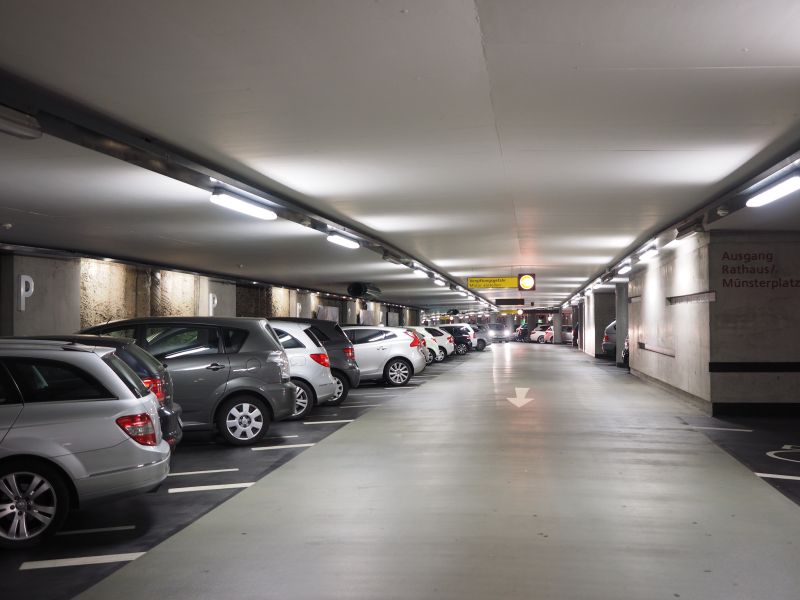
What exactly are you buying with a parking space?
A parking bay marked out by lines on a garage floor is usually not a separate property unit. When buying, it is particularly important to distinguish between the following legal arrangements.
- A share in a separately owned garage unit. In this case, the garage is a non-residential unit with its own land and mortgage register. The buyer acquires a co-ownership share in the garage.
- The right to use a space within the common property. The garage or car park forms part of the common property, and the apartment owner has been granted the exclusive right to use a designated bay under a co-owners’ agreement allocating use of the property (quoad usum). The buyer therefore does not acquire a separate share in a garage unit.
The term “parking space” in a sales listing does not, by itself, explain which legal arrangement applies. The draft agreement needs to be compared with the land and mortgage register, the garage plan and the documents establishing separate ownership of the units.
When acquiring a share in a garage unit, the buyer becomes a co-owner of the entire unit. The size of the share alone does not determine which parking space they may use. Similarly, an apartment owner with a share in the common property is entitled to use its common areas, rather than only the floor on which their apartment is located. A specific parking bay is usually allocated for exclusive use under an agreement dividing use of the garage unit, known as a quoad usum arrangement.
The agreement should clearly identify the number and location of the parking bay within the garage, define the exclusive right to use it and ensure access to the entrance gate, manoeuvring areas and garage exits. The garage plan attached to the agreement must allow the space to be identified without relying on the developer’s verbal assurances. If temporary numbering is used, it is worth stipulating that a change of number does not entail a change in the bay’s location or specifications.
You should also establish who may make changes to the allocation of use, on what terms, and how the rights of subsequent purchasers of shares will be regulated.
The form of the preliminary agreement
If the transaction is governed solely by the general rules of the Polish Civil Code, a preliminary agreement for the sale of a garage share may be made in ordinary written form. However, signing the agreement as a notarial deed provides stronger protection for the buyer. Provided the other requirements are met, it allows the buyer to seek a court order compelling the seller to enter into the final agreement if the seller refuses to do so.
An agreement in ordinary written form generally allows the buyer to claim compensation for the loss suffered as a result of relying on the final agreement being concluded. This does not automatically mean recovery of all the benefits the purchase would have brought. The parties may agree on a different scope of compensation.
We explain the consequences of choosing the form of an agreement in more detail in our article on preliminary agreements for the sale of real estate in Poland.
Parking spaces and the Developer Act — protection of payments
Acquiring a share in a garage does not always attract the same legal protection as buying an apartment. Article 2(2) of the Developer Act covers certain agreements concerning a non-residential unit or a share in one, entered into together with an agreement concerning an apartment or house within the same development project or investment task. Legal commentary notes that “a typical non-residential unit functionally linked to the residential unit being acquired, characteristic of a development project, will be a self-contained non-residential unit serving as a single-bay or multi-bay garage” [see B. Gliniecki, in K. Osajda (ed.), Ustawa deweloperska, commentary on Article 2, note 28; translation from Polish].
Accordingly, acquiring a share in a garage unit together with an apartment may qualify for protection under the Developer Act, including protection of payments towards the price of that share. If the agreement meets the requirements of Article 2(2) of the Act, these funds should be paid into a residential escrow account and are protected by the Developer Guarantee Fund on the statutory terms. However, such protection should not be assumed when purchasing only a garage share, independently of an apartment. Before making a payment, it is therefore worth checking the structure of the agreement and the account specified for payment of the price.
By contrast, a standalone purchase of a garage share, without the above connection, generally falls outside the protection of the Developer Act.
Before signing the agreement and making a payment, you should therefore establish whether the garage price is covered by a residential escrow account and protection under the Developer Guarantee Fund. It is not enough for the developer to state that these safeguards apply to apartment sales in the development. The agreement should set out clear rules governing the specific payment towards the garage.
Documents and developer’s representations before signing
The developer’s representations in the agreement should precisely describe the legal status of the property and the terms of the transaction. The buyer should ask the developer to provide documents allowing those representations to be verified. Depending on the purchase structure and the stage of the development, these will primarily include:
- the land and mortgage register numbers for the land and the separate garage unit, if its register has already been opened,
- documents confirming the seller’s title to the land and the authority of the persons signing the agreement,
- a garage plan identifying the bay, access route and relevant installations,
- documents setting out the allocation of use and the rights of other users,
- documents concerning mortgages, easements, claims and legal access to the garage,
- the specification of works, garage rules and the basis for calculating charges,
- at the final agreement stage, the documents required to transfer the rights and confirm that the building may lawfully be used.
A representation that the property is free of encumbrances should be checked against the land and mortgage register maintained for the property, including any entries noting applications that the land and mortgage register court has not yet determined as at the date of the representations. If separate ownership of the garage has yet to be established, you should check the documents needed to establish its separate ownership and open a land and mortgage register.
Payment of the price before ownership is transferred
An obligation to pay the entire price before the notarial deed is signed means that, for a period, the buyer finances the transaction without yet owning the share. The risk is particularly significant if payment is made into the developer’s ordinary account and the final agreement is still many months away.
Before transferring funds, establish the deadline for transferring ownership and the rules for refunding payments if the transaction falls through. Where the mandatory payment protection system does not apply, it is worth negotiating payment closer to the signing of the deed or security for repayment. A notarised undertaking to refund the money does not, by itself, eliminate the risk of the seller’s insolvency.
An advance payment (zaliczka) and an earnest money deposit (zadatek) have different legal effects. An advance payment does not automatically entitle the buyer to receive double the amount paid. The effects of an earnest money deposit depend on the agreement, the reason for non-performance and whether the requirements of Article 394 of the Civil Code are met. The entire contractual provision matters when assessing the payment, rather than just the description used in the bank transfer.
We discuss the settlement rules in more detail in our article on deposit in preliminary property purchase agreement.
A mortgage securing a loan taken out by the developer does not necessarily prevent the purchase of a parking space. However, it is essential to establish the terms on which the buyer will acquire a share in the garage unit free of that mortgage.
The mortgage creditor, usually the bank financing the development, may issue a document consenting to the establishment of separate ownership of the garage unit and the transfer of a share in it free of the mortgage, or to the release of the share being acquired from the mortgage — depending on the property’s legal status. It may also undertake to give such consent once specified conditions have been met, primarily payment of a stated amount into the appropriate account.
Before signing the agreement, check whether the document covers the specific share being acquired, what conditions must be met and whether the payment arrangements in the agreement will allow those conditions to be satisfied. The developer’s assurance that the mortgage will be discharged in the future does not provide sufficient protection for the buyer.
Access to the space across other plots and garages
On larger residential estates, the route from the public road to the parking bay may cross several properties or, for example, pass through the garage beneath a neighbouring building. The physical possibility of driving through does not establish that the buyer has a lasting legal right to use the entire access route.
If there is any doubt, check before purchasing the space that there is a legal basis for driving across every section of the route. In particular, the terms of any easements should be examined. Pedestrian access and the right to use ramps, gates and entry control systems also matter.
The agreement should also explain whether access depends on completion of a further stage of the development and what arrangements apply in the meantime. If access to other buildings is to pass through the garage in which the parking space is being purchased, establish how the costs of maintaining, servicing and repairing the shared infrastructure will be divided.
Installations above the bay and the obligation to provide access
The position of pipes, ventilation ducts, columns and technical equipment may restrict parking. You should therefore compare the parking bay plan with the installation drawings and actual conditions in the garage. The outline of the bay alone does not determine whether it will be possible to open the doors freely or park a taller vehicle.
If the agreement imposes an obligation to make the bay available to maintenance teams, check the rules for notification of planned works, the expected period of unavailability and liability for damage. Routine inspections and emergencies requiring immediate access naturally need to be addressed differently.
When purchasing a space on a parking platform, also check the permitted vehicle dimensions and weight, operating arrangements, maintenance costs and the consequences of equipment failure. Before buying, make sure the restrictions are compatible with the vehicle the buyer intends to use in the future.
Powers of attorney and consents granted to the developer
The agreement may require the buyer to grant the developer a power of attorney to establish easements, change ownership shares or enter into further agreements on use of the garage. Such powers may facilitate completion of the development, but their scope should be precisely defined so that they are not excessively broad.
Clauses allowing the developer unilaterally to change the allocated bay, worsen the access route, burden the garage with additional rights or impose costs not agreed with the buyer require particular scrutiny. A blanket consent to all future changes makes it difficult for the buyer to assess the actual scope of their obligations.
Powers of attorney also frequently include provisions describing them as “irrevocable”, allowing the appointment of substitute attorneys, and authorising self-dealing or representation of both parties. However, the mere inclusion of a provision in a notarial deed does not establish that it is binding on a consumer, as it may constitute an unfair contract term.
Handover of the parking space and maintenance costs
The agreement should specify precisely when the buyer will receive access to the bay, together with remote controls or access cards, and when charges for using it will begin. Establish the components of those charges, their calculation basis and the rules for allocating shared costs. Expenditure on gates, ventilation, cleaning, parking platforms and repairs is particularly relevant.
At handover, check the location and specifications of the space, room for manoeuvring, operation of the gates and visible defects, including leaks and floor damage. Defects should be recorded in the handover report and documented with photographs. If technical problems are suspected, obtain specialist assistance.
We also discuss documenting defects in our article on apartment handover from a developer and rectification of defects. However, the special procedure for apartment handover should not automatically be applied to a standalone purchase of a garage share. The legal basis for claims and the procedure for reporting defects must be established separately for the particular transaction.
Selling the parking space later
A share in a separately owned garage unit can generally be sold independently of ownership of an apartment. Before proceeding, ensure that use of the allocated bay is properly regulated and acquaint the new buyer with the existing agreements governing use of the garage.
The position differs where the space forms part of the common property and the right to use it is linked to ownership of an apartment. You cannot assume that this right can be sold separately on the same basis as a share in a separately owned garage. Whether and how the person entitled to use the space can be changed requires an examination of the documents and any necessary consents.
Buying a parking space as a foreigner
A foreign buyer should assess the purchase of an apartment, a garage share and any share in an access road or parking plot separately. An exemption applying to one component of the transaction does not automatically mean that the other components are exempt.
Article 8(1)(1a) of the Act on the Acquisition of Real Estate by Foreigners provides an exemption for a self-contained non-residential unit intended for use as a garage, or a share in such a unit, where the acquisition serves to meet the housing needs of the buyer or the owner of real estate or a self-contained residential unit. However, the exemption for the acquisition of a self-contained residential unit does not extend to properties located in the border zone, including Gdańsk, Gdynia and Sopot, as well as places such as Świnoujście, Kołobrzeg, Ustka, Łeba, Władysławowo, Jastarnia and Hel.
The garage exemption should not automatically be applied to a share in a separate plot containing an outdoor car park either. The structure of the right being acquired, the buyer’s citizenship and other statutory grounds for exemption all matter. If a permit is required, the transaction timetable and the treatment of payments if the Ministry of the Interior and Administration (MSWiA) refuses the permit need to be agreed accordingly. We explain the procedure and the documents required for an application in our guide to MSWiA permits for the acquisition of real estate by foreigners.
How we can help with buying a parking space
Verdict Partners helps buyers verify transaction terms and prepare amendments to the documents. Our support includes:
- reviewing the preliminary agreement and draft notarial deed, including annexes and regulations;
- identifying the type of right being acquired and the terms of exclusive use of the designated bay;
- checking land and mortgage registers, mortgages and bank documents concerning the release of property from encumbrances;
- checking legal access and the costs of using the garage, including easements and agreements concerning infrastructure;
- assessing powers of attorney and consents granted to the developer and preparing proposals to limit their scope;
- negotiating payments, deadlines and the parties’ liability, and, for foreign buyers, assessing whether an MSWiA permit is required;
- pursuing claims concerning delays, defects and refunds of payments, taking account of the legal basis of the particular agreement.
Before signing, send us the draft agreement, its annexes and the land and mortgage register numbers. We will check the scope of the right being acquired and identify provisions worth changing before you pay the price.
FAQ
A bay marked out by lines does not usually have its own land and mortgage register. A register may be maintained for the entire separately owned garage unit in which the buyer acquires a share. If the car park forms part of the common property, its legal status must be established from the property’s register and the documents governing its use.
Yes, if the legal structure and terms of sale allow it, for example where a share in a separately owned garage unit is sold. However, protection of payments and access to the estate’s infrastructure need to be checked separately. A right to a space in the common property should not be treated in the same way as a separate share in a garage.
The possibility of a change depends on the contractual provisions. A general clause should not be assumed to give the developer unlimited discretion. It is worth stipulating that a change in the bay’s location or material specifications requires the buyer’s consent.
No. A preliminary agreement only creates an obligation to enter into the final agreement. Payment of the price and delivery of a remote control do not replace an agreement transferring ownership either. When separate ownership of a garage is established for the first time, the constitutive entry of that ownership in the land and mortgage register is also relevant.
Above all, the subject matter of the purchase, allocation of the bay, the seller’s legal title, encumbrances and access. You should also establish the account for payment, the scope of protection for the funds, the deadline for transferring ownership and the settlement rules if the purchase falls through.